Mission
Our mission is to thoughtfully curate and steward a living landscape—selecting and nurturing plants, creating habitat, and shaping spaces that invite people to learn, create, and connect with nature and one another.
A Retrospective and a Look Ahead
We’re perched on roughly ~90 acres in the Finger Lakes of New York—a landscape with a history that stretches well beyond Flock.
In late fall 2020, after two years of searching for land in the Finger Lakes, we found ~90 acres here and began the process of making it home.
The land has taken on many lives over the years. For 28 years, portions of it were home to a well-respected garden center and container nursery. Before that, much of the property appears to have been largely fallow, with a single condemned house remaining on the land in the 1970s.
The forests tell another part of the story. Much of the woodland consists of relatively even-aged stands of hemlock, maple, and oak—roughly 60–70 years old—suggesting that these areas were cleared at some point for marginal grazing and lumber harvest, likely in the late 19th and early 20th centuries. Tucked among them, however, are individual trees and pockets of older forest on the steepest slopes that seem to have escaped that cycle of clearing. Some have been estimated to be 200–300 years old (Mike DeMunn, Onödowá’ga:’ forester, conversation, 2021).
So Flock is not a landscape untouched by people. It is a landscape that has continually changed with them.
Our role now is simply the next chapter in that story: to steward the land toward greater biodiversity, resilience, and ecological richness, while creating a place where people can learn, create, work, play, and connect—with nature and with one another.
Sander grew up in a small town in the Netherlands, where he developed an early appreciation for making things by hand, figuring out how things work, and finding creative solutions to problems. His interests first led him toward architecture and carpentry before eventually taking him into motion graphics and visual communication.
Today, Sander is a motion designer and visual storyteller whose work helps people bring ideas to life. His skills have been sought out by brands including Google, IKEA, Squarespace, Strava, and Airbnb, among others. He also co-created BlendFest, a popular motion design festival, with a group of friends.
At Flock, those worlds naturally converge. Sander brings his designer’s eye and maker’s mindset to everything from building and landscape projects to documenting the ongoing evolution of the property. He is also the camera and creative force behind the Plant One On Me and Flock YouTube channels, where he helps share the stories, experiments, and ideas growing out of this place.
Summer Rayne grew up in Northeastern Pennsylvania surrounded by farms, fields, and forests. If her hands weren’t in the dirt, they were likely drawing, observing, or documenting the natural world around her. From an early age, she was drawn to finding creative ways to share her fascination with nature and make it accessible to a wider audience.
That impulse eventually took her into the worlds of fashion, food, and entertainment, where she found unconventional ways to bring environmental ideas into the mainstream. She became known as one of the early pioneers of eco-conscious fashion and has collaborated with brands including Timberland, Levi’s, and Pirelli.
She later studied environmental science and entomology at Cornell University, deepening her understanding of the living systems that had fascinated her since childhood. Today, she continues to explore the intersection of plants, ecology, creativity, and communication through Plant One On Me and Flock.
At Flock, Summer brings together her lifelong curiosity about the natural world with her passion for storytelling, gardening, and ecological stewardship. Flock is, in many ways, an extension of the questions she has been exploring throughout her life: How can we live more closely with nature—and how can we inspire others to do the same?
Joey is a Canadian-born photographer and director whose work has taken him around the world in pursuit of stories, people, and places that capture his curiosity. Drawn to adventure and ever-changing environments, he has built a career around environmental portraiture and visual storytelling, working with clients including National Geographic Channel, the History Channel, Canon, the U.S. Army, Summit Entertainment, Lavazza Coffee, and others.
His personal projects have taken him far beyond the studio, from documenting ascetics and endangered cultures to photographing guerrilla fighters in Kurdistan and exploring the diverse cultures of Ethiopia. His work has appeared on major billboards and in publications including Vanity Fair, The Sunday Times, and The Atlantic.
As one of Flock’s founding partners, Joey brought this same spirit of curiosity, exploration, and visual storytelling to the creation of the place. While his role at Flock has evolved over time, his contribution to its beginnings remains an important part of the story of how Flock came to be.
We believe meaningful change happens together.
Our partners help us extend our mission, bring new ideas to life, and make Flock what it is today.
ArcheWild is a restoration nursery whose mission is to restore maximum landscape function by supplying and installing diverse, ecoregion-specific native plants with wild genetics.
Their approach to native plants and ecological restoration closely aligns with our own efforts to build a more biodiverse and resilient landscape at Flock. That shared vision is what led us to offer a portion of our land as one of ArcheWild’s operational Founder’s Plots. Through their seed collection, plant growing, and ecological expertise, they’re helping us bring more of Flock’s vision to life—while bringing the benefits of regionally adapted native plants to landscapes beyond our own.
Garden Vision is dedicated to developing exceptional perennial plants, drawing largely from native species to create selections that bring beauty, resilience, and outstanding garden performance to the landscape.
At Flock, we’re always looking for plants that can do more than simply look beautiful. We want them to enhance the gardens and landscape, support ecological processes, and perform well over time. But a plant that thrives in a large landscape doesn't always thrive in a garden setting or vice versa.
Together we work with Garden Vision to test tried-and-true garden selections to see which ones can truly thrive. It’s an ongoing process of observation —and a way for us to discover plants that bring together horticultural excellence, beauty, and resilience.
Espoma Organic is a fifth-generation business whose mission is to develop the finest organic gardening products that work in harmony with nature, grow beautiful gardens, and make a greener world for the future.
We’ve been partnering with Espoma for nearly a decade, using many of their organic soil and fertilizers throughout the gardens here at Flock. Over the years, we’ve come to share their belief that growing beautiful, healthy plants can go hand in hand with working in harmony with nature—and that organic gardening should be accessible to everyone, whether you’re tending a garden outdoors or growing plants inside your home.
Spaces
In 2021, we began the long and rewarding process of reshaping the landscape at Flock—creating gardens and planting areas designed not only to be beautiful, but to support wildlife, restore ecological function, and knit the landscape together.
Since then, we’ve embarked on nearly two dozen garden and landscape projects, each shaped by the unique conditions of the land. Some are experiments: opportunities to try something new, observe what happens, and learn from the results. We share many of these experiments and discoveries on our YouTube channel.
More than 4,000 different kinds of plants have now found a place across the landscape, nearly 40 percent of them native to New York State and the High Allegheny Plateau Ecoregion. Together, these plantings are helping us create a landscape that is more diverse, resilient, and alive. Our goal is to work with the land, discover what can thrive here, and create beautiful, useful, and ecologically rich spaces that can be enjoyed by the people and wildlife who call Flock home.
Landscape
An insect meadow is a native meadow designed to provide food and habitat for insects—not just pollinators, but the countless herbivorous species that depend on native plants for their survival. By growing a diversity of native plants, we’re creating habitat that can support insects throughout their life cycles, while also providing food for the birds and other wildlife that depend on them.
Creating this meadow meant first undoing decades of intensive land use. In June 2021, nearly 96 tons of material—from geotextile fabric and tile drainage to other remnants of the former container nursery—were removed from this nine-acre site. Thousands of invasive honeysuckle and multiflora rose plants were also cleared.
Once the site was cleaned up, it was graded and prepared for planting. Throughout the summer and fall of 2021, we planted and disked in three rounds of cover crops to help rebuild and prepare the soil.
We ultimately seeded and planted more than 80 different kinds of plants, primarily native species, transforming what had once been a highly managed nursery site into a diverse meadow designed with insects and the wider ecosystem in mind.
Orchard
The Orchard is one of the few garden areas at Flock designed in straight lines, following the natural slope of the land in a more traditional permaculture-inspired approach. The rows are oriented to help slow and capture rainwater as it moves downhill, while creating an organized framework for a diverse collection of perennial plants.
Planted between 2022 and 2025, the Orchard brings together familiar fruit crops, native fruit-bearing trees and shrubs, and a mix of edible and medicinal plants. Currants, gooseberries, pears, cherries, apples, and strawberries grow alongside native species such as serviceberry, chokeberry, persimmon, blueberry, and elderberry.
We’ve also tucked in some less expected plants, including Camassia, wild licorice, ground cherries, and wild hyacinth. The result is an orchard that is as much a living experiment as it is a source of food—layering horticulture, ecology, and abundance into a single landscape..
Garden
In September 2021, we began removing a portion of the front lawn to make way for a highly diverse pollinator garden. Rather than focusing solely on plants that attract a wide range of generalist pollinators, the garden emphasizes the importance of including specialist plants—species that provide essential food or habitat for particular insects with more specific needs.
Today, the garden contains more than 350 different kinds of plants, including both species and cultivars, with 44 percent native to the United States. Together, they create a succession of blooms and resources for insects and hummingbirds from April through the end of October.
The garden is designed to provide habitat beyond the growing season, too. In fall, we leave the plants standing and allow them to go to seed, providing food for birds and places for insects to overwinter. Mason bee houses, frog and toad shelters, and shallow watering stations provide additional habitat and resources for the many creatures that make their home here.
The result is a garden designed not simply for flowers, but for the intricate web of life that depends on them.
Garden
A series of distinct but interconnected gardens surround the Common House, or “The Roost,” creating a living transition between the house, the gardens, and the landscape beyond.
The plantings were designed to soften the edges of the elevated deck and nestle the cedar-clad home into its surroundings, allowing the gardens and the larger landscape to take center stage. Throughout the plantings, we’ve emphasized unusual fruiting groundcovers and beautifully scented flowers—plants that offer something to discover for both people and insects.
But these gardens are about more than what grows in them. They’re designed as an extension of the house—an outdoor room that invites people to step outside, linger, and experience the landscape. From the deck and gardens, the view opens onto Half Lake and the rolling hills beyond, creating a natural stage for one of Flock’s most expansive views.
Garden
A landscape always carries traces of the people who have cared for it. The Memorial Garden was created as an homage to the former landowner, who ran the plant nursery here for 28 years and left his own mark on the property through the many interesting trees and shrubs he planted along the way.
Rather than erase that history, we wanted to build upon it—a garden in honor of someone who clearly loved plants. Its palette of blues, reds, and purples takes its cues from two existing anchors: a large blue fir and a red Japanese maple that were already growing in the bed.
Around them, we planted nearly 300 different kinds of plants, with an emphasis on low-growing herbaceous groundcovers and ground-hugging conifers. Together, their layers of texture and subtle color create an almost underwater quality, giving the impression of a living coral reef spread across the garden floor.
It’s a garden meant to reward attention at every scale—from the intricate textures and details revealed up close to the larger composition that emerges from a distance.
Landscape
In the fall of 2021 and 2022, we planted more than 80,000 spring-flowering bulbs throughout the lawn surrounding Flock’s Common House. Inspired in part by Sander’s Dutch roots, the project also gave us an opportunity to rethink what a lawn could be—transforming an otherwise quiet stretch of grass into an ever-changing tapestry of color and an early-season source of food for bees and other pollinators.
The bulbs begin emerging as early as February, with the display continuing through the end of May. Over time, they will naturalize throughout the lawn, multiplying both vegetatively through bulb offsets and sexually through seed. With each passing year, the hope is that the planting becomes increasingly abundant and integrated into the landscape.
The project was also a celebration of community. Friends, fellow gardeners, landscapers, and members of Cornell University came together to help plant thousands of bulbs, turning what could have been a monumental task into a memorable shared experience.
Landscape
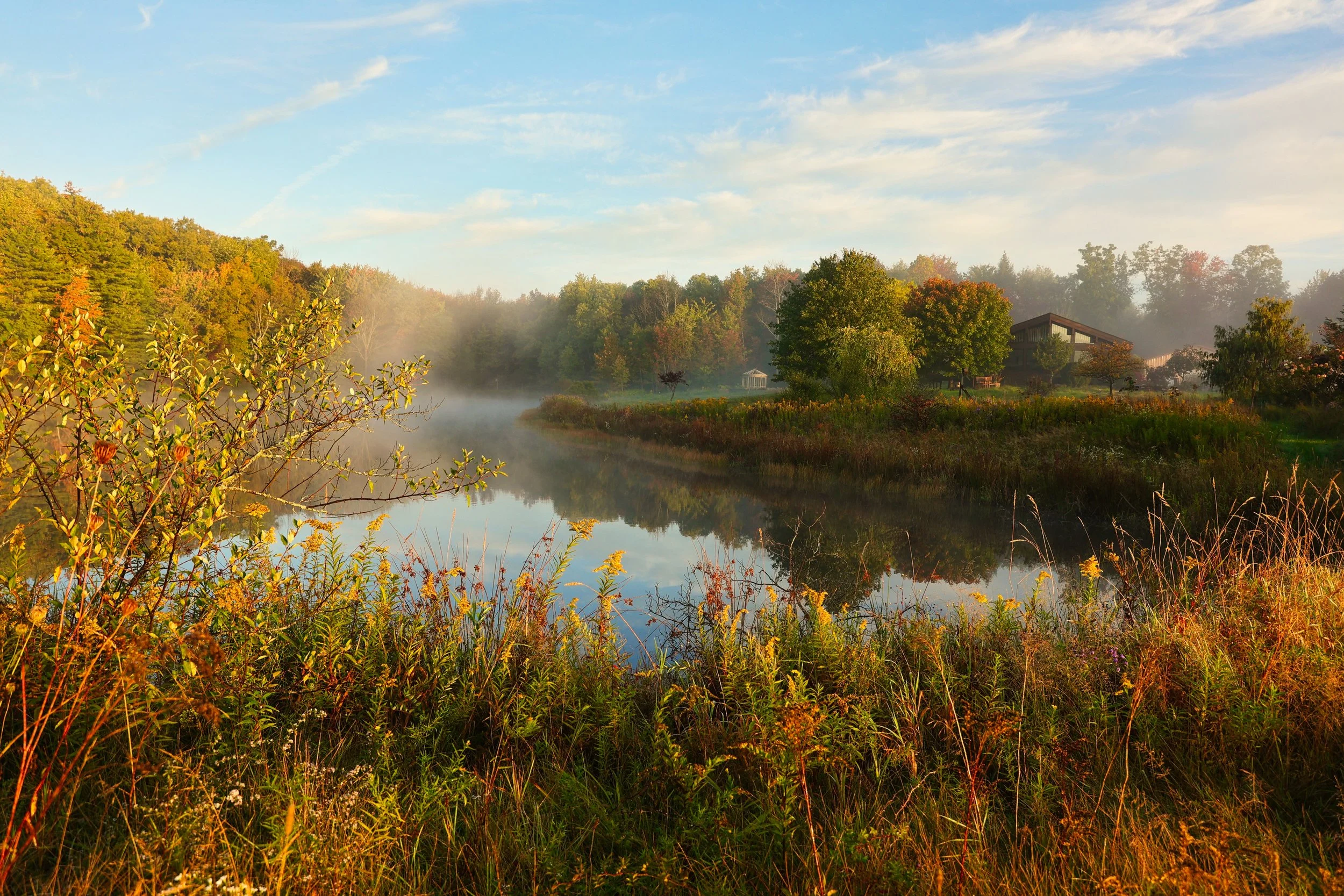
Half Lake is Flock’s largest body of water, spanning approximately 2.5 acres. For much of the year, we leave its edges largely to themselves, allowing native sedges, rushes, grasses, and flowering plants to grow naturally along the transition between land and water. Invasive and unwanted species—including Rosa multiflora, Lonicera, and Elaeagnus angustifolia—are periodically removed to give native vegetation more room to thrive.
Since 2022, we’ve also been enrichment planting the shoreline with native wetland plants, with the hope that established populations will eventually spread and provide a source of seed for the other ponds and wet areas across Flock.
We’ve placed particular emphasis on species that are rare, threatened, endangered, or locally extirpated—plants that have become uncommon or disappeared from portions of their historic range. Among them are Euonymus americanus, Eutrochium dubium, Campanulastrum americanum, Mimulus alatus, Eryngium aquaticum, Hasteola suaveolens, Helianthus angustifolius, Lysimachia quadriflora, Iris prismatica, Lobelia cardinalis, Scutellaria incana, and Chelone glabra, among others.
In this way, Half Lake is becoming more than a pond. It is a living wetland garden and a kind of native plant reservoir—where we can encourage populations of plants that are increasingly difficult to find, while allowing their seeds and influence to extend into the wider landscape.
Garden
Installed in the fall of 2023 by the skilled local stonemasons at O’Brien Masonry, the Fossil Footpath winds its way around the Herb, Pollinator, and Shrubbery Gardens, creating inviting paths and new vantage points from which to experience the plantings.
But there’s more to the path than meets the eye. Embedded among the stones are fossils from both the Finger Lakes region and much farther afield, tucked into the pathway as little discoveries along the way.
As you wander through the gardens, keep your eyes down—you might be surprised by what you find. See if you can spot them all!
Garden
The Meadow House Cottage Gardens are a series of seven interconnected gardens tucked into just one-eighth of an acre. Charming, approachable, and a little whimsical, they were designed with the relaxed abundance of a traditional cottage garden, while weaving in edible plants, cut flowers, and a generous mix of native species.
Traditional cottage garden favorites like Alcea, Delphinium, and Digitalis mingle with native plants such as Symphyotrichum, Coreopsis, Penstemon, and Liatris, creating a garden that feels both familiar and distinctly connected to the surrounding landscape.
The gardens unfold from the cottage patio, where terracotta pots spill over with plants, through climbing roses and Clematis trained onto trellises, and onward to the roadside fence. Espaliered apple trees, raspberries, honeysuckle, Dutchman’s pipe, and even more Clematis add layers of fruit, flowers, fragrance, and vertical interest.
Willow wattles and weathered logs define the garden edges, giving the spaces a homespun, rustic character that feels at home alongside the cottage.
And if you happen to spot Farro and Flax wandering through the beds, don’t be surprised. The resident ducks love nothing more than patrolling the gardens in search of slugs, snails, and other tasty garden visitors.
Landscape
When we created the Native Insect Meadow, there were a few areas we couldn’t seed because of the slope. One of them was the hillside behind the Meadow House, which was covered almost entirely in a monoculture of reed canary grass.
We wanted to transform this overlooked slope into something beautiful and biodiverse—both for the people enjoying the view from the Meadow House porch and for the pollinators and wildlife that could make use of it.
So, rather than taking a single approach, we experimented. Over the course of three years, we tried several different methods for converting the grass into a native meadow: solarizing sections with tarps, planting native plugs, direct seeding, and eventually installing native meadow sod to create a diverse matrix of plants.
The result is still evolving, but by early to mid-September, when the Liatris and Solidago are at their peak, the meadow comes alive. Dozens of monarchs and hundreds of other pollinating insects descend on the flowers, turning the hillside into a spectacular—and very rewarding—display.
It’s a small meadow, but it embodies something we’re learning again and again at Flock: sometimes the best way to discover what works is simply to try, observe, and try again.
Structures
For nearly 30 years before Flock, the land and buildings were home to a beloved plant nursery known for its collection of rare and unusual container-grown plants. In 2022, we began the process of reimagining these spaces—renovating the existing buildings to sit more naturally within the landscape while giving them new purposes that reflect the evolving story and spirit of Flock.
Homes
This 600-square-foot former nursery office has been transformed into a quiet, habitable oasis overlooking the meadow and the cottage gardens.
Inside, the walls and ceiling are finished in earthy clay, troweled by hand to create a warm, tactile surface. The spa-like bathroom is finished in hand-applied tadelakt and limestone, giving it a soft, monolithic quality. Throughout the day, natural light enters from every direction, casting shifting shadows across the walls and revealing the subtle textures of the materials.
Much of the furniture and millwork was made by local craftspeople. The kitchen cabinetry and banquette were designed and built by Sander, one of Flock’s founding partners, whose growing passion for carpentry has found a natural home in the many building projects here. Elsewhere, furniture and homewares from auctions, estate sales, and artisan shops, sourced by Summer Rayne, give the cottage a simple, eclectic character while maintaining a sense of cohesion.
Outside, the original structure was given a new identity with reverse board-and-batten hemlock siding, a nod to the agricultural buildings and barns found throughout the region. Patios on the east and west sides of the cottage create an easy transition between indoors and out, inviting you into the gardens on one side and the expansive meadow on the other.
Today, Meadow House serves as a home, studio, and guest house for family and friends at Flock—a small retreat shaped as much by its materials and craftsmanship as by the landscape that surrounds it.
Cottage Renovation Before/After - Meadow House Tour
After you add your text and image in the "Content" tab, you can customize the layout of your section in the "Design" tab. Images can be beside, above, or below your text.